

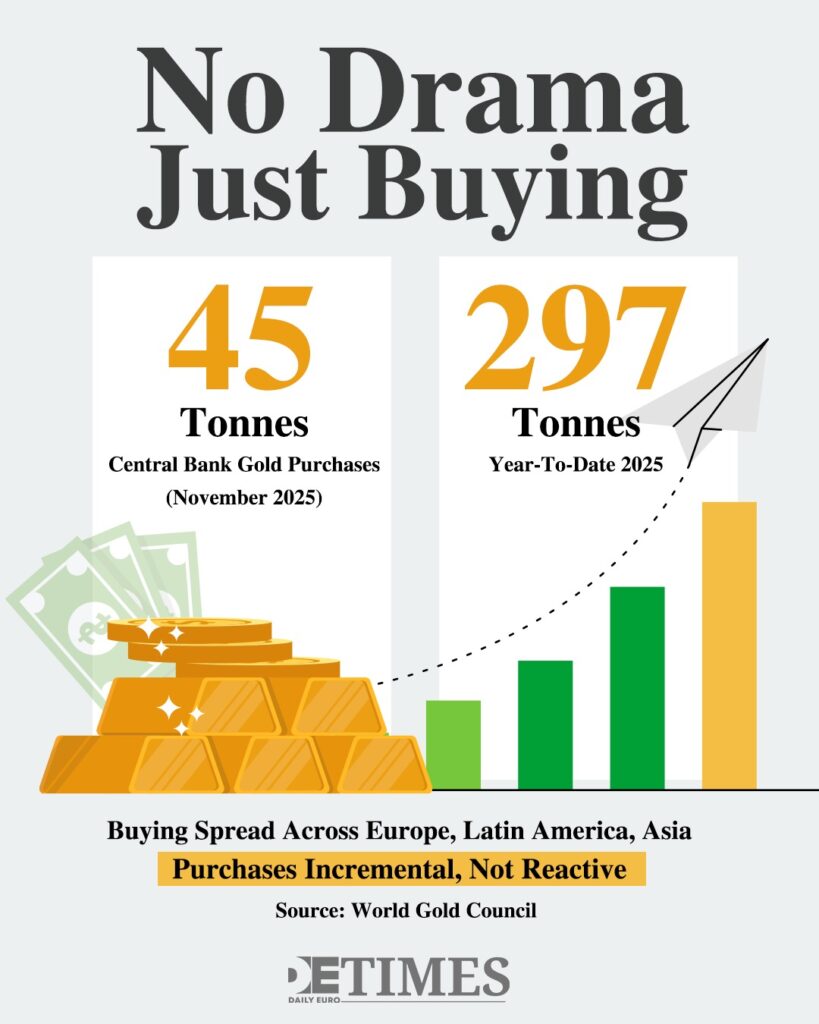
As central banks bought 45 tonnes of gold in November 2025, pushing year-to-date purchases to 297 tonnes, an old instinct resurfaced.
Gold headlines usually arrive with drama. This time, the shift has been subdued. No formal return to a gold standard, no declarations of monetary rupture. Instead, a slow accumulation, a hedging gesture repeated across continents. The language of markets frames this as dedollarisation or de-fiatisation. Yet gold’s return says less about replacing currencies than about distrust in systems that feel overstretched.
No Gold Standard, Just Doubt
There is little serious momentum behind reviving a gold-backed monetary system. Modern economies are too large, too liquid, and too leveraged for such rigidity. Even policymakers flirting with the idea rarely propose it beyond rhetoric.
Central banks have increased gold holdings as a counterweight to fiat exposure, especially as interest rates, debt levels, and geopolitical risk pull in opposite directions. According to the World Gold Council, Poland led November 2025 purchases with 12 tonnes, whilst Brazil added 11 tonnes for the third consecutive month.
This is not a vote against the dollar as a currency. It is a hedge against concentration, against the idea that one system can safely absorb every shock without consequence.
Dedollarisation as Insurance
Much of the recent commentary around gold treats dedollarisation as a coordinated revolt. The reality is less theatrical. Trade is still priced in dollars. Debt is still serviced in dollars.
Gold’s appeal lies elsewhere. It does not depend on payment networks, correspondent banks, or political alignment. It carries no counterparty risk and no loyalty requirement.
In that sense, gold functions as insurance rather than ideology. It is not about abandoning fiat money, but about admitting its limits.
Before Markets, Memory
Long before central banks debated balance sheets, gold lived elsewhere. It lived in homes, jewellery boxes, and dowries. It moved through generations not as speculation, but as precaution.
In many societies, women were gold’s primary custodians. Excluded from formal finance, property ownership, or inheritance rights, they held value in the form that could not be frozen, seized, or quietly erased.
Bracelets, earrings, coins sewn into fabric. These were not adornments alone. They were personal reserves, portable and discreet.
Gold as Quiet Agency
This history matters because it reframes today’s conversation. Gold was never only a market instrument. It was a way to retain agency in systems that denied it.
Across the Middle East, South Asia, North Africa, and parts of Southern Europe, women’s gold functioned as emergency capital. It could fund a child’s education, escape a bad marriage, or survive a currency collapse. According to CNN, India purchased 611 tonnes of gold jewellery in 2021, whilst the Middle East bought 241 tonnes, with bridal jewellery accounting for over 50 per cent of India’s gold market share.
That memory persists. Even now, in households that fully participate in digital finance, gold retains a symbolic role as something solid when trust thins.
The Appeal of the Tangible
Modern finance has become increasingly abstract. Money moves as code, value appears on screens, and access depends on platforms working as intended. When systems fail, the failure feels total.
Gold sits outside that abstraction. It does not promise growth or efficiency. It does not scale elegantly. It simply exists.
This lack of ambition is precisely its appeal. In a culture trained to expect optimisation, gold offers continuity instead.
After Crypto’s Disenchantment
Gold’s renewed relevance also follows the fading of crypto’s grand claims. Digital assets promised liberation from fiat dependence and institutional control. What many delivered instead was volatility and fragility.
Gold offers no such promises. It does not pretend to be modern. It waits.
That contrast matters. People increasingly distinguish between instruments that demand belief and those that function without it.
Balance, Not Nostalgia
It would be a mistake to frame gold’s return as a longing for the past. There is little romance in central bank vaults or inherited jewellery weighed on kitchen scales.
What connects these worlds is restraint. Gold imposes limits. It resists infinite expansion and forces recognition of scarcity.
That constraint feels newly relevant in economies built on perpetual growth narratives.
A Material Vote of No Confidence
Gold’s quiet return is not a rejection of modernity. It signals discomfort with how far abstraction has travelled without accountability.
Women holding gold did not do so out of ideology. They did it because systems failed them, and gold endured. Today’s institutions are rediscovering the same logic.
Goldman Sachs projects gold prices will reach $5,400 per ounce by year-end 2026. J.P. Morgan forecasts around 755 tonnes of central bank purchases in 2026, still elevated compared to pre-2022 averages of 400 to 500 tonnes. These are not prophecies, but precautions.
Gold is not taking over. It is waiting, exactly as it always has, for moments when trust thins and memory reasserts itself.
Keep up with Daily Euro Times for more updates!
Read also:
Why Spain and Latin America Defy Washington’s Venezuela Policy
U.S. Wants Türkiye to Hand Back Enigmatic Jet Gear
De-Dollarisation: The Future of World Currency