
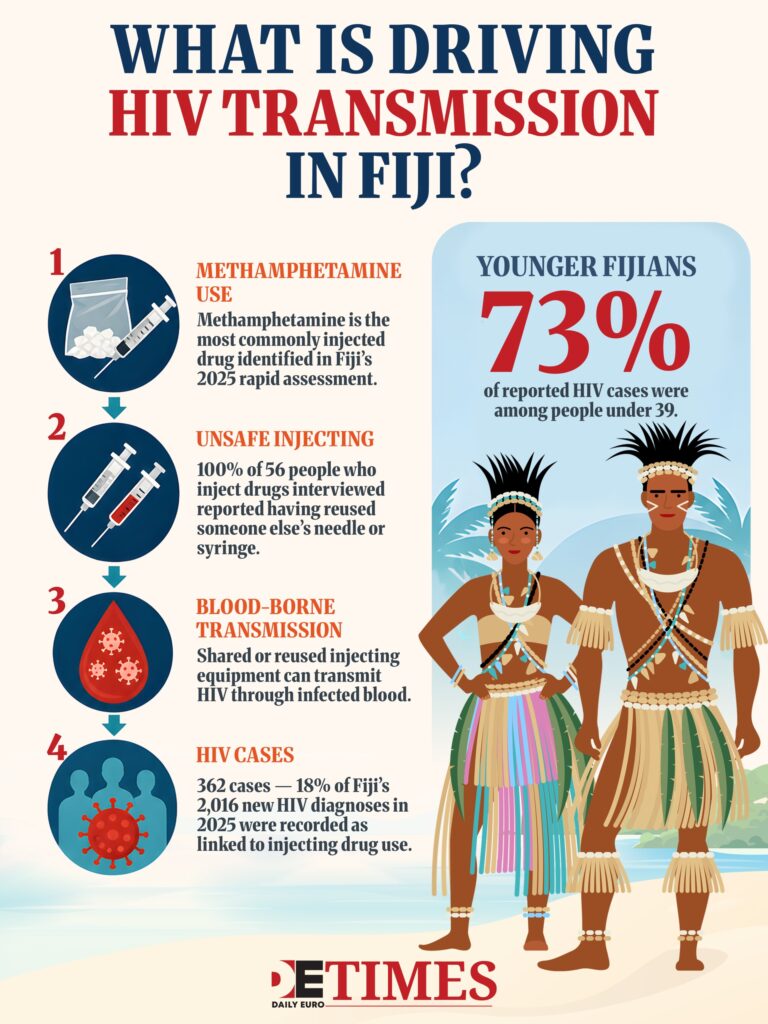
Officials in Suva confirmed 2,016 new diagnoses of the Human Immunodeficiency Virus, or HIV, across Fiji last year. Health Minister Antonio Lalabalavu declared the emergency and said an “outbreak-level response is no longer sufficient.” One in 60 adults on the archipelago lives with the virus, up from one in 167 five years earlier, according to Fiji’s Ministry of Health and Medical Services.
Fiji’s government first flagged an outbreak in January last year, long enough ago for warnings to accumulate before Suva reached for the word “emergency.” A methamphetamine crisis, needle sharing and a practice called “bluetoothing,” in which users inject already-circulated blood to chase a fading high, have driven transmission among younger Fijians. Winnie Byanyima, executive director of the Joint United Nations Programme on HIV/AIDS, UNAIDS, called the surge “a stark reminder to the world that AIDS is not over.”
Suva secured a mutual defence guarantee from Canberra in barely a year of negotiation, signing the Ocean of Peace Alliance last July. Compare the speed of the alliance against years of epidemiological warnings, which drew only incremental funding.
Defence Deals Multiply Around Fiji
Australia’s Ocean of Peace Alliance with Fiji arrived days after the Nakamal Agreement with Vanuatu, and roughly a year after the Pukpuk treaty with Papua New Guinea.
Canberra frames each pact as protection against coercion, though officials avoid naming Beijing outright. Fiji’s prime minister, Sitiveni Rabuka, insists the arrangement exercises sovereign choice without breaking Suva’s economic ties with China.
Economic ties still count here. China remains a major trading partner and infrastructure financier across the Pacific, and Rabuka has resisted casting the alliance as a rupture. His caution means smaller governments can play competing patrons against each other for security and investment, leaving public health chronically underfunded regardless of which capital they lean on.
Greenland Meets a Familiar Pressure
The thinking that drove Australia toward Fiji resurfaced in Washington’s approach to Greenland last week. Donald Trump announced an agreement granting Washington “permanent control over security” on the Danish territory, after months of threatening annexation.
Denmark’s government describes the deal as protective of Greenlandic self-determination and insists sovereignty stays intact. Washington’s stated goal is to keep rival powers, Russia and China among them, away from strategically placed waters and minerals.
Greenlanders themselves report limited enthusiasm. Officials in Nuuk have spent recent years fending off pressure and asking for scant protection of their own, an arrangement echoing the power imbalance visible in Chagos and the Falklands.
Argentina renewed its claim on the Falklands soon after London ceded the Chagos archipelago to Mauritius, reviving a question Diego Garcia has posed for decades.
Strategically located territories carry a bargaining value their populations rarely see returned in their own budgets.
Waterways Outweigh Public Health Needs
Fiji, Greenland and the Chagos archipelago occupy shipping lanes, mineral reserves and military chokepoints whose value registers in distant capitals well before it reaches the people living there. Investment appears wherever strategic value already exists.
Australia’s Vuvale Union promises Fiji over a billion Australian dollars across a decade, a sum larger than anything on offer for Fiji’s own health ministry. The ministry’s HIV strategy draws heavily on UNAIDS and international funding, with little coming from its own recurrent budget.
Small governments have every right to trade access for guarantees, and Rabuka’s caution about overcommitting to any one patron looks prudent. The imbalance lies elsewhere. Donors rarely condition security partnerships on comparable health investment.
Fiji recorded fifty-nine HIV-positive births last year, and eighteen of those infants died before their first birthday. Such a toll calls for urgency at least equal to any missile test in the South Pacific.
Keep up with Daily Euro Times for more updates
Read also:
The Battle for Influence in the Pacific
New Zealand Surfed Out of the Pacific: China Waved In
Chagos, Vanuatu and Falklands Turn Into Diplomatic Millstones

