
The old language of moving abroad no longer fits neatly here.
People once relocated for family, exile, study, or a slower reinvention of self. Today, a growing number of younger professionals move through cities the way companies move through markets, optimising for tax, visa conditions, administrative speed, and proximity to clients.
Dubai understands this shift better than most, and has spent several years engineering its systems accordingly. The pitch is straightforward: zero personal income tax, fast company registration, strong digital infrastructure, and a civic apparatus designed to reduce professional friction rather than introduce it.
That clarity is, in itself, a form of appeal even after the ongoing war spiralling from Iran’s unlawful strikes on the commercial capital and wider GCC.
The Numbers Behind the Move
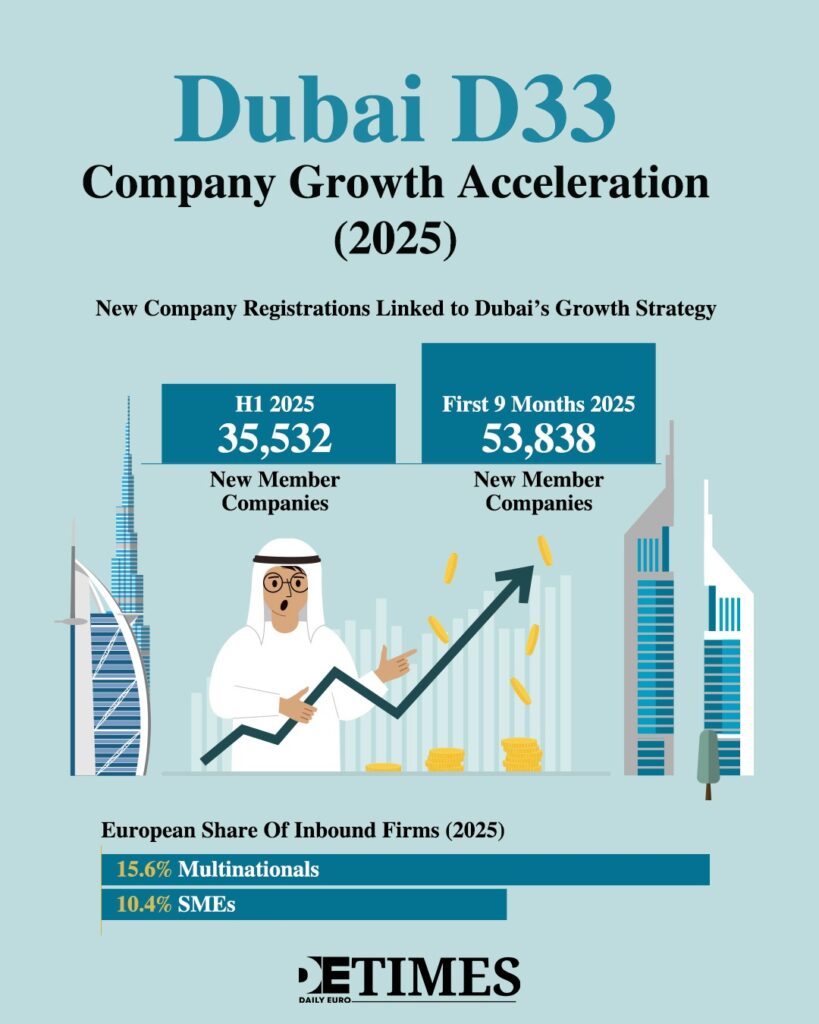
The scale of inbound business activity is considerable. Dubai Chamber of Commerce welcomed 35,532 new member companies in the first half of 2025 alone, marking four per cent year-on-year growth, and that figure reached 53,838 across the first nine months of the year according to the chamber’s own published data.
European companies represent a meaningful share of that inflow: Dubai International Chamber reported that Europe accounted for 15.6% of the multinational companies it attracted to the emirate in 2025, and 10.4% of the SMEs it brought in. These are not dramatic figures in isolation, but they reflect something more structured than lifestyle drift.
A city does not attract businesses at this rate by accident. It does so by making administration legible and growth paths clearer than in places where taxes are higher, permits slower, and professional life more bureaucratically layered.
A Visa System Built for Mobility
The residency infrastructure Dubai has built over the past several years is designed specifically to attract the kind of professional who wants options rather than permanence.
The Golden Visa, introduced in 2019 and expanded significantly since, offers ten-year renewable residency with no local sponsor required, covering investors, entrepreneurs, specialised talent, and skilled professionals in fields from technology to the arts.
Over 150,000 Golden Visas were issued (2019-2024), with a sharp increase in 2023 and 2024 as eligibility criteria broadened.
Alongside it, the Green Visa offers five-year self-sponsored residency for skilled professionals earning a minimum of AED 15,000 per month, and the Freelance Visa targets independent creatives, consultants, and developers working across multiple clients. For those not ready to relocate fully, a remote work permit allows professionals employed outside the UAE to live in Dubai for up to a year whilst maintaining their existing positions.
Dubai was ranked the number one city in the world for remote workers by RemoteWork360, a designation that reflects practical infrastructure as much as lifestyle. Average internet speeds reach 167 Mbps, co-working spaces are abundant, and the processing time for a freelance permit sits at five to seven business days across all nationalities.
The city’s free zones, including Dubai Internet City, Dubai Media City, and DMCC, offer 100 per cent foreign ownership and full profit repatriation, conditions that many European jurisdictions do not match.
Europe’s Quiet Problem
The more revealing question is not why Dubai attracts young professionals, but why so many feel that established cities at home no longer do enough to retain them.
This is less dramatic than brain drain and more structurally telling. Nobody is fleeing collapse. Many are simply tired of drag. High living costs, slower administration, heavier tax burdens on both individuals and small businesses, and dense regulatory environments can make daily professional life feel effortful in ways that no longer seem necessary to people who have grown up in digital systems that promise immediacy.
The UAE introduced a nine per cent corporate tax in 2023, bringing it closer to international norms, but personal income remains entirely tax-free, a fact that registers immediately for self-employed professionals and founders comparing jurisdictions. That calculation should concern governments more than ideological arguments about brain drain ever could.
Creative Life After Bohemia
The shift is especially visible in how creators and founders describe their moves.
Artistic migration once carried a mythology around it: people went to Paris or Berlin for atmosphere, struggle, and subculture, expecting difficulty and converting it into identity. The new version is more operational. Co-working spaces, production facilities, brand partnership networks, and audience growth tools are foregrounded in the same conversations that once centred on inspiration and community. Even creativity is now discussed through workflow.
The city provides the infrastructure; the professional provides the output.
It would be easy to read this as a flattening of something that once had more depth. That framing misses the point. The deeper change is that creative labour is now broadly expected to justify itself through scale and monetisation, and Dubai did not invent that expectation. It simply built a city that serves it efficiently, without apology and without the ambient resistance that many European capitals still attach to commercial ambition.
Freedom, Carefully Structured
There is a paradox worth noting in how Dubai markets itself.
It presents economic freedom with considerable intelligence, yet that freedom is highly structured. It operates through designated programmes, specific visa categories, free zone frameworks, and strategic agendas tied to the Dubai Economic Agenda D33, which targets doubling the city’s GDP by 2033. This is not frontier chaos.
It is managed openness, and that management is a significant part of the attraction. Many mobile professionals do not want radical freedom. They want predictable systems, quality infrastructure, and clear incentives. Dubai’s competitive advantage is not that it removes all friction, but that the friction it retains is legible and navigable in advance.
What Other Cities Can Learn
Dubai’s rise as a magnet for young professionals says something larger about the era.
Mobility is no longer primarily about escape or adventure. Cities now compete on administrative efficiency and the speed at which a motivated person can go from arriving to operating productively. The professionals making these moves compare jurisdictions the way businesses compare markets, asking which place will let them work faster, earn more cleanly, and build more visibly. Some of that calculation is cold.
Most of it is honest. Whether other cities choose to compete on those terms, adapt parts of the model, or continue assuming that talent will stay put out of habit and attachment, is a decision that will determine a great deal about which professional ecosystems thrive across the next decade.
Even in times of war, Dubai’s glimmer will not fade as young professionals aspire for a better life judged by efficiency, safety, and opportunity.
Keep up with Daily Euro Times for more updates!
Read also:
Perfume Capitals: Grasse Fields and Dubai Malls Compete for Status
Visa Denial: When Borders Become Weapons
Spain’s Digital Nomads: The Paradox of Remote Working