

Thick black smoke billowed from Ras Tanura, the largest refinery in Saudi Arabia, after Iranian-made Shahed-136 drones struck the site on the Gulf coast this week. Though Saudi air defences caught both aircraft, falling debris ignited a fire that forced the people working there to flee.
Saudi Aramco halted work at the plant, which processes 550,000 barrels every day, as a safety measure. The refinery pulls crude from Ghawar, the largest oilfield on earth, to feed markets in China, Japan, and Europe.
The pause came after another hit at a nearby gas site earlier in the week, making the event the second blow to Saudi exports in under seven days. Saudi authorities blamed Iranian forces, but the economic judgment delivered by the markets eclipsed any debate over the military choreography.
Gasoil futures leapt and Brent crude surged by nearly 10%. At the same time, Iranian drones hit the Ras Laffan gas complex in Qatar. The attack forced QatarEnergy to stop work and suspend shipments, and European natural gas prices rocketed upward by more than 50%.
Insurance Takes its Toll
In the days before the strikes, insurance costs for ships in the Strait of Hormuz had risen to 0.4% of what a vessel is worth. For large oil tankers, the increase added a quarter of a million dollars to the cost of every trip.
Major insurers including Gard, Skuld, NorthStandard, and the London P&I Club scrapped war protection for the region entirely. The standard freight rate for Very Large Crude Carriers hit a record of $423,736 a day.
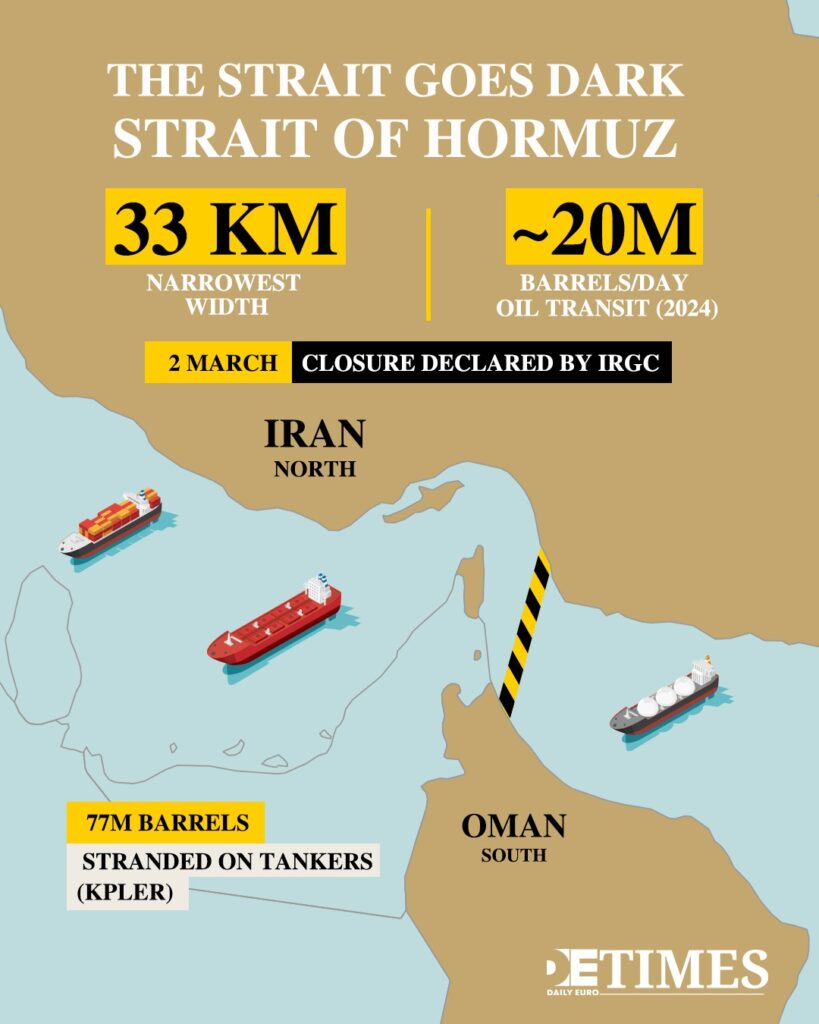
Earlier this week, a senior official declared the Strait of Hormuz closed to all shipping, a passage that handles 20% of the oil the world uses. Tanker traffic plunged to almost nothing as over 150 ships anchored outside the passage to wait for the danger to pass.
Tehran’s Leverage and Energy as a Geopolitical Tool
Iran’s assault on Gulf energy sites is rooted in a strategy of asymmetric endurance.
Sascha Bruchmann of the International Institute for Strategic Studies told the Associated Press that the goal is to cause global backlash and put a high price on the American president.
Torbjorn Soltvedt of Verisk Maplecroft warned of a long period of suspicion as Iran targets trade routes and security partners. Luciano Zaccara of Qatar University stated that a strike on Iran ensures a global effect.
Reassurance Arrives as Fragility Persists
Following the closure, President Donald Trump acted by ordering the U.S. Development Finance Corporation to provide new insurance for all trade in the Gulf. He promised that the Navy will begin escorting tankers soon.
The announcement echoed the tanker missions of the 1980s, but with a third of the fleet already busy with combat, the ability to do the mission remains in question.
American stocks trimmed their losses on the news, and the Dow Jones reduced its decline to 301 points. The brief relief gave way to the cold logic of the market.
Goldman Sachs noted that the primary danger to the world economy is how long the energy shock will last. The ING team wrote that the war has landed on a trading system already fractured by tariffs and previous supply chain crises. Elias Haddad of Brown Brothers Harriman warned that a long conflict raises the risk of stagflation and worsens fiscal pressure.
Spreading Fronts Defy Official Reassurance
The widening conflict makes any official reassurance feel fragile. The Revolutionary Guard operates under a decentralised method that ensures it can keep fighting even if its leaders are gone.
In Iraq, a coalition of militias claimed drone strikes against U.S. bases. In Yemen, the Houthi movement announced it would resume attacks in the Red Sea, which threatens the secondary route that had kept trade moving. Europe entered the year with very little gas storage, and now the benchmark Dutch price climbed to an oppressive €60 per megawatt hour.
Yousef M. Alshammari told Euronews Business that a long ordeal will lead to a painful increase in home energy bills. Simone Tagliapietra wrote that the disruption makes the case for moving away from global fossil fuel markets.
Europe only learned of the U.S. strikes as they started, which captures the plight of a continent bearing the costs of a war it cannot control. The calculation of economic war runs against the official narrative. Tehran uses the devastating efficiency of drones to generate oil price swings worth billions of dollars.
Strategist Umud Shokri warned that global energy security remains dangerously fragile. Claudio Galimberti compared the disruption to a blocked artery in the circulatory system. The longer the strait stays closed, the worse the damage will be for people whose governments promised them that no effects were on the horizon.
Keep up with Daily Euro Times for more updates!
Read also:
Europe’s Largest Warship: Securing Defence Autonomy in Air-Sea Battle
Who Really Holds the Power in Europe’s Energy Supply?
Secession After Annexation: U.S. Alberta Oil Bid