

On 18 January, Benin’s electoral commission disclosed a result that effectively wiped the presence of the opposition out of the government.
The Democrats, the country’s primary dissenting voice, secured a 16 percent share of the national vote, yet the 20 percent threshold required for entry precipitated a parliamentary vacuum for the group.
The outcome leaves the National Assembly under the consolidated hegemony of two parties loyal to President Patrice Talon, coming a month after authorities extinguished a brief coup attempt in Cotonou.
Economic Expansion Within a Consolidated System
Mr. Talon, a businessman who built a cotton fortune before taking office in 2016, has sustained an upward fiscal trajectory throughout his tenure.
Growth reached 7.5 percent in 2024, propelled by a relentless schedule of port modernisation and infrastructure projects that have expanded to include telecommunications and energy.
The administration’s vision is anchored in a $20.6 billion agenda aimed at a fully internalised industrial revolution. At the Glo-Djigbé Industrial Zone, which processes 40,000 tonnes of cotton annually, the state has moved to keep all value-addition within its borders.
With growth projected at 7.0 percent for 2025, the country stands as a regional leader in macroeconomic management – an achievement attained through a highly centralised and disciplined governance model.
A New Regional Standard for Stability
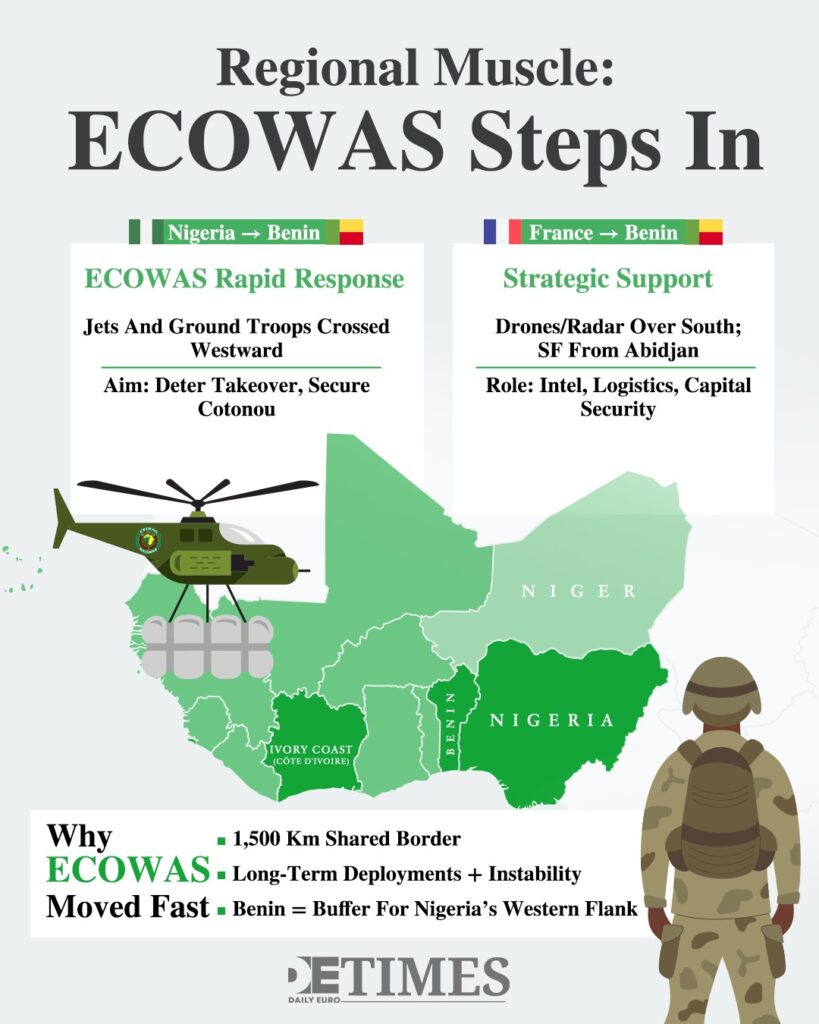
As the December coup attempt surfaced, Nigerian President Bola Tinubu reacted with enough military force to signal a definitive end to regional patience for such uprisings. He deployed fighter jets and ground troops under the ECOWAS banner, a manoeuvre that showed an active defence of the current order.
France lent the unavoidable logistical and surveillance backbone for the operation, with special forces dispatched from Abidjan to ensure the capital remained in government hands.
The coordinated response exposed Nigeria’s commitment to a predictable western flank. The cost of a military government in Benin would have forced a permanent deployment along a 1,500-kilometre frontier, making the preservation of the current administration a matter of urgent interest for Abuja.
The Infrastructure of Global Interests
Central to this regional stability is the 1,950-kilometre Niger-Benin Oil Pipeline, which commenced operations in May 2024.
The massive conduit, uniting Agadem’s oilfields to the Gulf of Guinea, was constructed by the China National Petroleum Corporation and acts as a multi-billion-dollar anchor for regional trade.
The pipeline has turned Benin into a critical transit hub for landlocked Niger’s exports, and Chinese diplomats have already exhibited their commitment to keeping these flows active by mediating border frictions.
The infrastructure is the silent driver of the international community’s protective stance, as the pipeline embodies a convergence of Chinese investment and regional income that requires a strictly maintained domestic peace.
The Continuity of the Heir Apparent
Looking toward the 2026 presidential elections, the political path has been unobstructed for Finance Minister Romuald Wadagni, who is now the preferred candidate after the primary opposition candidate was disqualified under rigorous endorsement rules.
Mr. Wadagni, a 49-year-old veteran of Deloitte with extensive associations in global financial capitals, has spent nearly a decade as the architect of the country’s fiscal policies.
Lately, Mr. Talon has also brought Mr. Wadagni into defence matters, grooming him to manage the economy alongside the rising security pressures from the north.
This transition plan offers a guarantee of policy continuity for partners abroad, as a Wadagni presidency embodies the maintenance of a reliable buffer against the broader instability currently affecting the Sahel.
Stability Through Strategic Alignment
Benin’s current trajectory is defined by an exchange of political diversity for predictable governance and economic expansion. International partners have increasingly prioritised the prevention of military rule, showing a preference for a stable system even if the voting is closed.
The alignment of Nigerian airpower, French intelligence, and Chinese infrastructure has established a system where technical competence is the primary measure of success.
The upcoming April election will determine whether the framework of manufactured consensus can endure.
Benin remains a test case for whether a population, seeing the tangible benefits of economic expansion, will continue to accept a system built on the deliberate exclusion of the opposition.
Keep up with Daily Euro Times for more updates!
Read also:
Benin, Harbouring Militants? Burkina Faso and Niger Think So
Africa on Stream: IShowSpeed and a New Online Map of the Continent
New Sahel Alliance Tariffs Threaten ECOWAS and AfCFTA Goals