
July14 , 2026

The GCC in the Heart of Europe: Saudi and Emirati Investment in Real Estate and Tech

Related

Is Farage Heading for the Dustbin?

Nigel Farage quit Parliament to fight a rubbish-bin mascot for his own seat, wagering that grievance beats scrutiny in the court of public opinion.

Attal Uses Clavicular to Redefine His Political Brand

When a presidential candidate attacks an American streamer for mocking France, the influencer arena stops being parallel to politics and starts becoming part of it.

Buried Circle in Scotland Rewrites Violence Before Rome

Scotland's Buried Circle Rewrites Violence Before Rome Keywords: Neolithic Scotland, Machrie Moor, conflict, stone circles, archaeology, Roman Britain Brief: Standing stones in moorland mist; a bronze blade laid beside excavated earth.New discoveries at Machrie Moor and a major Edinburgh exhibition are pushing Scotland's prehistory away from pastoral myth and closer to a landscape of ritual, memory and organised violence.Scotland's ancient past is often imagined in stone, fog and silence. The newest archaeology suggests something noisier. Historic Environment Scotland this week announced the detection of a possible new prehistoric ring beneath the peat on the Isle of Arran: a circle of 12 pit-like anomalies forming a feature approximately 28 metres across, with space for two additional settings that may bring the original total to 14 posts or stones. Led by Dr Nick Hannon, the survey team used geophysical scanning equipment that detects underground disturbances without lifting a single turf. "The discovery of a new circle completely surpassed our expectations," Dr Hannon said. The find arrives at the same moment as the National Museum of Scotland opens Scotland's First Warriors, an exhibition tracing 4,000 years of conflict from the Neolithic to the Romans, covering more than 200 objects and asking how and why people fought, what weapons they used and what early conflict did to communities. Taken together, the two stories complicate the old image of early Scotland as a remote edge of prehistory waiting passively for civilisation to arrive. Ritual and Conflict Shared the Same Landscape It is tempting to separate ceremonial monuments from warfare, as if one belonged to religion and the other to politics. The new exhibition suggests prehistoric Scotland did not organise life so neatly. Machrie Moor's circles date from between roughly 3500 and 1500 BCE, and excavations have shown that several were preceded by timber circles in the same positions. The timber circle at Machrie Moor 1 has been radiocarbon-dated to 2030 ± 180 BCE, before the wooden posts were replaced with stone around 2000 BCE. The circles align with a prominent notch at the head of Machrie Glen, where the midsummer sunrise would have been visible, and later served as burial grounds for cremations and inhumations. The Edinburgh exhibition changes the emotional map of prehistoric Scotland. Stone circles were not necessarily built by peaceful mystics untouched by danger. They belonged to societies capable of both ceremony and force, burial and battle, symbolic order and lethal dispute. As the exhibition makes clear, interpersonal violence, fortification and organised conflict were real parts of Scotland's deep past, not marginal episodes but structural features of life on the moor. The landscape was never only sacred space. It was lived space. Before Rome, There Was Already History The most useful thing about these discoveries is that they pull Scottish prehistory out of the shadow of Rome. Too often, Britain's northern story begins when classical writers notice it. The Arran circle and the "first warriors" frame both insist that Scotland already had long, structured histories of monument-building, territorial meaning and conflict before Roman contact ever entered the picture. The Arran cursus, a ceremonial enclosure approximately 1.1 kilometres long sitting adjacent to the stone circles, underlines the landscape's sustained importance as a gathering place across millennia. The new ring at Machrie Moor has not yet been excavated, and the evidence for prehistoric violence remains open to interpretation. But the direction of travel is clear. Early Scotland looks less like an empty northern fringe and more like a dense world of ritual landscapes, armed communities and social memory stretching back 5,000 years. The stones were never mute. We are only getting better at hearing what kind of world they belonged to.Keep up with Daily Euro Times for more updates! Read also: The Outlander Effect: How the Show Put Scotland on the Map Rural Europe Pushes Back Against Megafarms Homer in a Mummy Rewrites Cultural Borders

Sahel Grows Increasingly Hostile Towards Foreign Powers

Rebel fighters push deeper into northern Mali as Sahel rulers sever old alliances and gamble on defending their territory alone.

Europe vs. America: The World Cup’s Hidden Culture War

A racist jibe, a disputed red card and a peace prize have turned the 2026 World Cup into an unlikely stage for transatlantic tension.

Share

In recent years, investment flows from the Gulf countries have increasingly been directed to Europe not only into traditional real estate, but also into high-tech sectors.

The activities of the sovereign wealth funds of Saudi Arabia (Public Investment Fund, PIF) and the United Arab Emirates (ADQ, Mubadala, Abu Dhabi Investment Authority) are particularly noticeable.

Real Estate: Entry Point to “Take Root”

For wealthy families from the UAE and Saudi Arabia, European real estate is not only an asset protected from inflation, but also a strategic resource.

Buying properties in the UK, France, Germany and Spain is considered part of “Plan B“: a place for children, education, business, and in some cases, a second passport.

Therefore, the demand for luxury housing in London from Middle Eastern clients increased by +43% in 2023 according to Knight Frank.
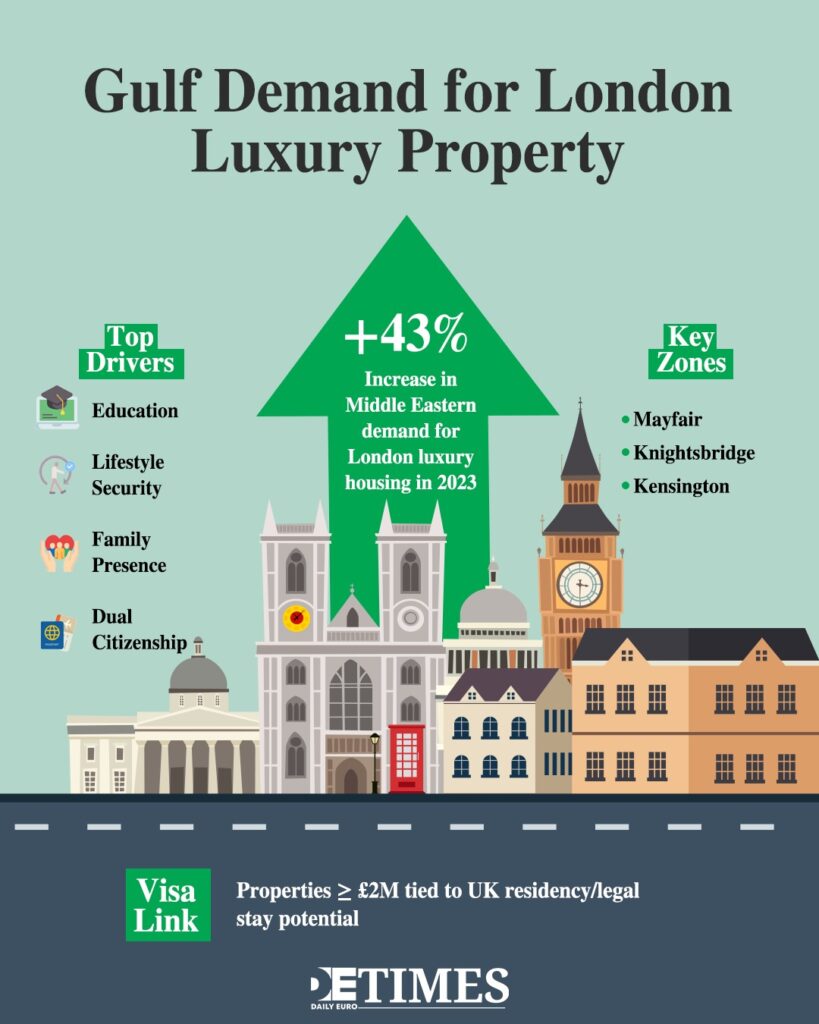
The GCC in the Heart of Europe: Saudi and Emirati Investment in Real Estate and Tech  Daily Euro Times
The GCC in the Heart of Europe Saudi and Emirati Investment in Real Estate and Tech

Of particular interest are properties with access to prestigious schools, medical centres, and the ability to quickly obtain a residence permit. In some countries, such as Portugal or Greece, this is directly linked to “golden visa” programs.

Tech Shift: Petrodollars to a Startup Ecosystem

While petrodollars used to go to banks and construction, today they are increasingly going to European startups. Sovereign funds are actively investing in FinTech, AI, healthcare, green technologies, and logistics.

Berlin has become a hub for investing in startups in the field of sustainable technologies and mobility; for example, PIF funds have invested in startups working with electric vehicles and urban mobility,

London is also attracting venture capital investments in fintech and medical technology from Emirati state backers: Mubadala and ADQ.

These funds have already invested in companies such as Klarna and Cera. Paris has become an attractive destination for Middle Eastern funds thanks to the rapid growth of technology accelerators and state support from the French government.

Investment Incentives

  • Political Insurance: In an unstable region, owning assets in Europe provides legal and physical protection.
  • The Next Generation: Families from the UAE and Saudi Arabia want to integrate their children into the international community via British universities, Europe’s business environment, and a Anglophone culture.

Europe is becoming not just an investment destination, but a strategic partner for the Gulf countries.

This is not only capital, but also cultural exchange and the transformation of the cities themselves. For Europe, this is an opportunity to attract resources, create jobs, and strengthen its position in the global economy.

Read the Latest Articles on DET! 

Confessions and Invisible Tragedies: Why Cheating is More Popular than Death

A New Wave of Bioethics: The Frontiers of Genetic Engineering

Malta Shuts the Door on ‘Golden Passports’: Contribution, Not Direct Investment

Your Mirror to Europe and the Middle East.

We don’t spam! Read more in our privacy policy