
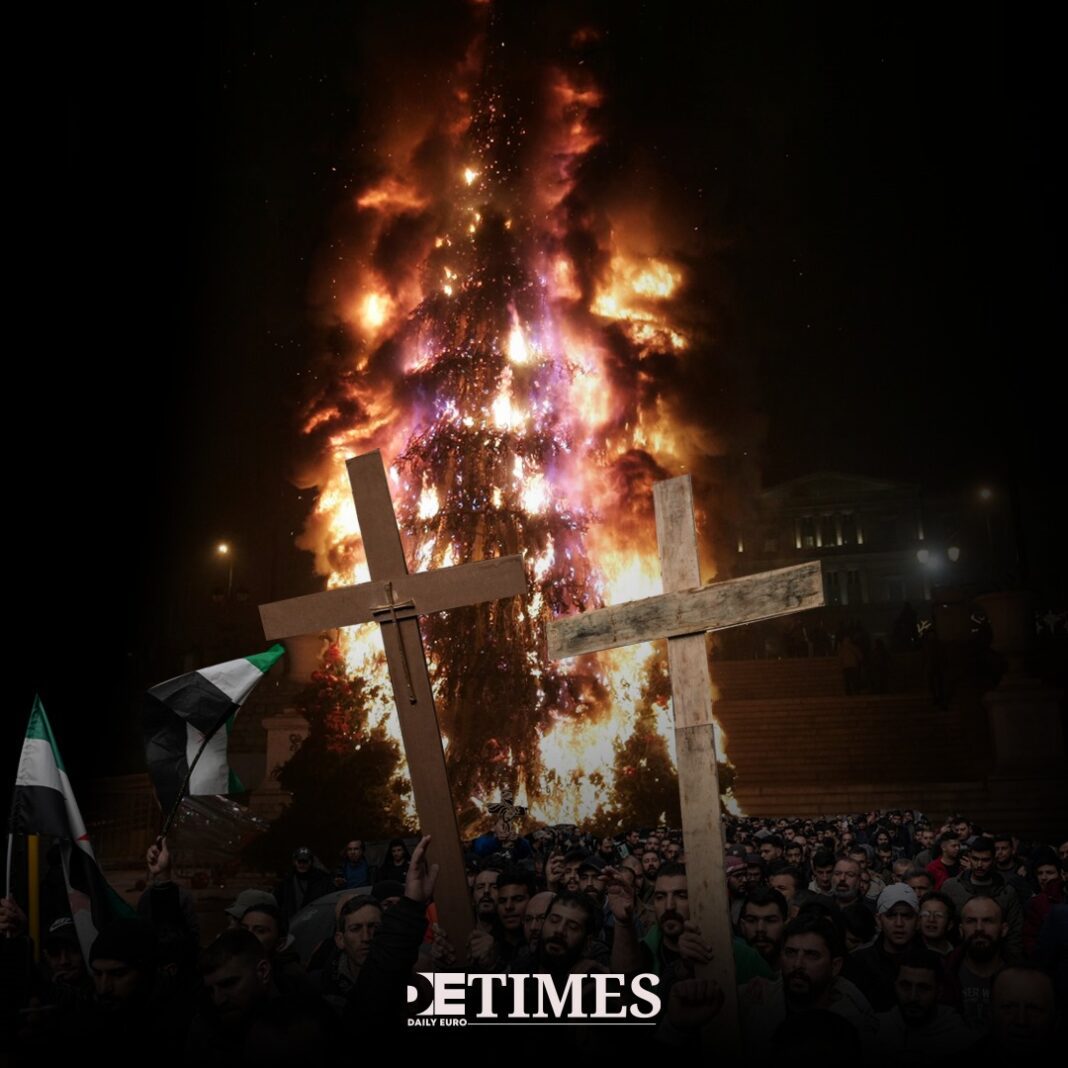
Protests erupted in Syria following the burning of a Christmas tree in Al-Suqaylabiyah, a Christian-majority town in central Syria. The incident has raised questions about the protection of minorities under the new Islamist-led authorities.
A video circulating on social media shows the Christmas tree engulfed in flames in Al-Suqaylabiyah’s main square. Hayat Tahrir al-Sham, the Islamist group now in control after the fall of President Bashar al-Assad’s regime, stated that foreign fighters were detained in connection with the arson. HTS has pledged to safeguard the rights of Syria’s religious and ethnic minorities, though the incident casts doubt on their ability to deliver on this promise.
A Shocking Incident
Footage posted online shows masked men pouring an unidentified liquid on the Christmas tree just hours before Christians in Syria were set to celebrate Christmas Eve. Whether they intended to extinguish the fire or accelerate its spread remains unclear.
A religious representative from HTS responded to the gathered crowd, assuring them that the tree would be restored before morning. In a rare gesture of solidarity, he held up a cross—a symbolic act uncharacteristic of Islamist conservatives.
Nationwide Protests
The arson sparked demonstrations beyond Suqaylabiyah, with protesters taking to the streets in Damascus. In the Kassa neighbourhood, demonstrators called for the departure of foreign fighters, chanting, “Syria is free; non-Syrians should leave.” Meanwhile, in Bab Touma, a Christian district, protesters marched with crosses and Syrian flags, declaring, “We will sacrifice our souls for our cross.”
One protester, Georges, voiced his frustration: “If we’re not allowed to live our Christian faith in our country, as we used to, then we don’t belong here anymore.”
A Diverse Nation Seeking Security
Syria is home to a mosaic of religious and ethnic groups, including Christians, Kurds, Druze, Alawites, and Arab Sunnis, who form the majority of the Muslim population. Following the collapse of the Assad regime, many displaced Syrians have begun returning home. On Tuesday, Turkey reported that over 25,000 Syrians had crossed the Turkish-Syrian border back home for Christmas.
However, the arson attack reaffirms underscores the challenges HTS faces as it transitions from an Islamist group in charge of rebel-held areas to a fully functioning state apparatus governing Syria. The group, once rooted in hardline ideology, has pledged to create a Syria for all Syrians citizens. Incidents like this, before Christmas day, highlight the complexities of making such a shift.
A New Era, New Challenges
HTS announced plans to dissolve independent armed factions under a unified Ministry of Defense, aiming to centralise authority. However, questions remain about which groups will join this merger and how HTS will govern a fragmented nation.
While HTS remains a designated a terrorist organisation by the UN and Western nations, diplomatic overtures suggest a potential shift. Recently, the US removed a $10 million bounty on HTS leader Ahmed al-Sharaa following meetings with group representatives. However, the group still faces scrutiny over its ability to ensure security and uphold minority rights in a volatile post-Assad Syria.
A Test of Leadership
The Christmas tree arson incident is a test of HTS’s leadership and their commitment to inclusivity. Protecting minorities, managing foreign fighters, and addressing extremist threats will be crucial to stabilising Syria and fostering trust among its diverse population.
Keep up with Daily Euro Times for more updates!
Read also:
Syria at a Crossroads: The Southern Border
International Backlash to Settlement Expansion in Golan
From Terrorists to Rebels: Hay’at Tahrir al-Sham

