

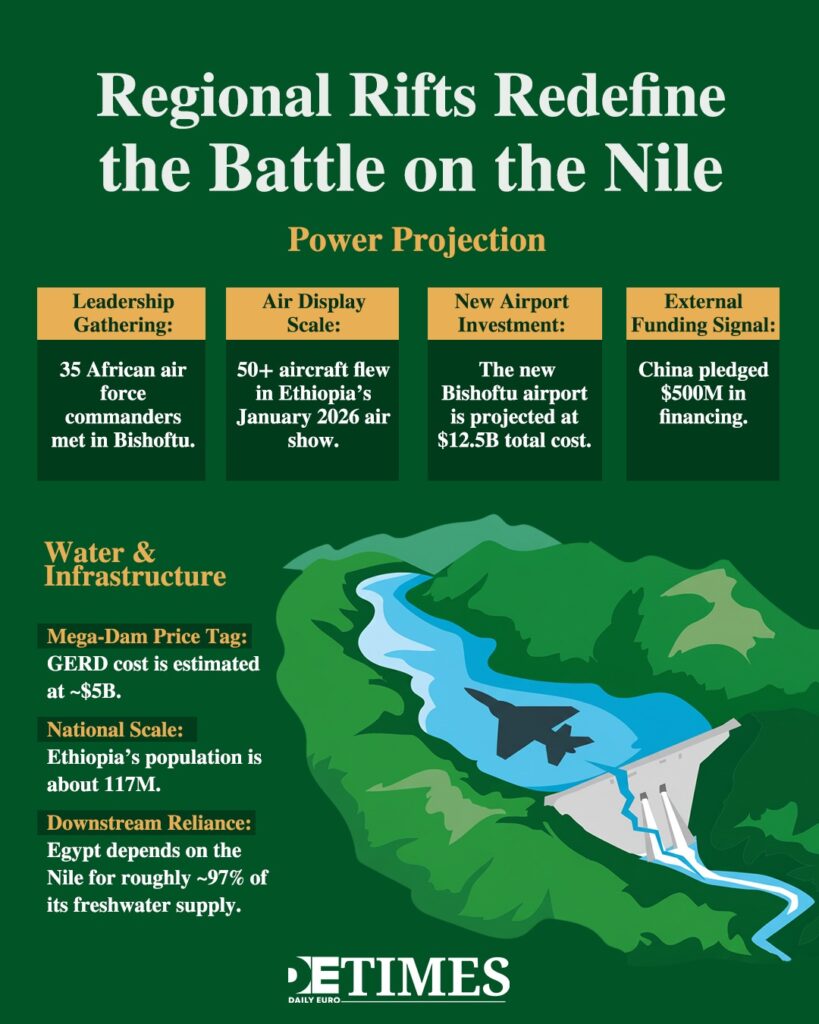
Last week thirty-five African air force commanders gathered at Bishoftu for an event that forced Cairo to look in two directions at once.
Prime Minister Abiy Ahmed inaugurated the Aviation Expo in the year two thousand and twenty-six on the twenty-third of January to honour ninetieth anniversary of flight in his country. The air force put more than fifty aircraft in the sky for a display called ‘Where the Lions Rule the Sky’.
The site in Bishoftu is only forty kilometres from the capital and will anchor an airport project that outdoes any other in Africa.
The display featured flights by pilots from the United Arab Emirates and the Czech Republic. The chronology of the event occurred as Egypt began to fret over its water supply due to the Grand Ethiopian Renaissance Dam.
Donald Trump Offers a Hand to a Fractured Region
President Donald Trump offered to resolve the water dispute on the seventeenth of January. Egyptian President Abdel Fattah el-Sisi thanked him for the idea. Mr Trump wrote in a letter that he was ready to start American mediation again to fix the Nile water sharing problem on a permanent basis.
Egypt favoured the intervention but the silence in Addis Ababa implies a preference for the solitude of autonomy.
Mr Trump has mentioned before that the United States helped pay for the dam. In a talk with NATO leaders last July he mentioned that Egypt cannot survive without the Nile. Ethiopia’s government rejected the claim by describing the project as a domestic triumph paid for by local citizens since the year two thousand and ten.
The assertion is of consequence because it informs Mr Trump’s stance as a mediator. The Council on Foreign Relations noted that Ethiopia might find the American initiative unwelcome. Citizens are very proud of the dam.
Prime Minister Abiy needs national pride as he is navigating internal security trials and friction with Eritrea and Somalia.
A Split in the Gulf Alters Red Sea Calculus
The offer to help arrived as the harmony between Egypt’s primary regional partners unraveled. Competition between Saudi Arabia and the United Arab Emirates erupted across southern Yemen recently. The fallout jeopardises the stability of states where each Gulf power holds a stake.
The Southern Transitional Council launched a large military push on the second of December to end the deadlock after years of stalemate. Saudi leaders now evaluate the Emirati actions as an attempt to dismantle existing state structures and redraw borders permanently.
Riyadh now views the Emirati-backed groups in southern Yemen as a direct threat to its own border safety. Saudi Arabia accused the UAE of reckless conduct. The UAE responded by describing the Saudi statements as inaccuracies.
The disagreement spans the entire Red Sea region. Saudi observers link the aforementioned developments to the rising international profile of Somaliland. That region recently won recognition from Israel. Ethiopia’s drive for a port through Somaliland adds another ingredient to the fight for dominance over regional shipping lanes.
Ethiopia GERD and Regional Power Projection
The water dispute grew more intense in September after Ethiopia launched its five billion dollar dam project. Since then Ethiopia’s close connection to the United Arab Emirates has grouped together several regional forces now focused on containing Ethiopia’s growing reach.
The aviation expo and the new airport carry heavy symbolic weight. Prime Minister Abiy laid a ceremonial plaque on the tenth of January to start work at the Bishoftu site. The price for the project has now climbed to twelve and a half billion dollars because of inflation.
A financial institution based in China has promised five hundred million dollars toward the airport. The head of Ethiopian Airlines shared the news during a meeting in Morocco.
Water Disputes Rarely Resolve Through Force
Water management agreements from the past provide a map for cooperation. The Indus Waters Treaty lasted through decades of war between India and Pakistan and provides a way for neighbours to communicate. The World Bank helped the nineteen hundred and sixty agreement after a neutral person contacted the leaders of both nations.
A similar productive result occurred along the Columbia River between the United States and Canada. The United States built dams in Canadian territory to generate power and reduce flooding. Canada received millions of dollars and a sixty year share of the electricity as a form of payment.
Such models work because they look toward shared gains and joint groups that meet often to exchange info. The talks over the Ethiopian dam have not had that kind of organisation on record.
Research attests to the fact that a coordinated operating strategy could allow the dam to help Egypt during droughts and maximise hydropower for Ethiopia. Studies imply the project can generate nearly all of its potential power without causing a water deficit for downstream communities if the right policies are identified.
Confluence or Collision
The changing geopolitical environment has left Egypt in a precarious spot. The Saudi foreign minister recently made an unannounced trip to Cairo. During that visit Egyptian officials expressed total support for Riyadh which is a choice that leaves little room for its previous decade of Emirati closeness.
The regional order is changing. The former allies have embraced the harsh light of public rivalry. They started the year by blaming each other in public.
Ethiopia’s growing connections with regional players are testing old assumptions about who holds power in East Africa. The aviation expo evidenced that Addis Ababa can bring together continental partners at the very site where its massive new airport will soon rise. The dam already controls the flow of the Nile. Ethiopia is building enduring physical realities on the ground that the old tools of diplomacy may no longer be able to reach.
Egypt still requires predictable water for its farms and people. Ethiopia needs electricity for its one hundred and seventeen million people. Neither side is likely to abandon its core interests for the sake of diplomatic niceties. The split between the Saudis and the Emiratis with Egypt firmly in the Saudi camp is the new backdrop for the dam dispute.
Whether Mr Trump’s mediation leads to real talks rests on if Ethiopia chooses to engage. The most productive water treaties in history took years of patient work to build.
The real question is whether the regional fractures will force countries to cooperate out of necessity or simply drive them further into competing loyalties. Ethiopia’s aviation display confirms that Addis Ababa sees itself as a rising hub. Cairo will have to find a way to live with that reality.
Keep up with Daily Euro Times for more updates!
Read also:
New Nile Order: Uganda Stands with Ethiopia Against Egypt’s Control
Nile Tensions: South Sudan at Risk of Renewed Conflict
A Skeleton of Itself: How Isaias Afwerki Grounded Eritrea Down