

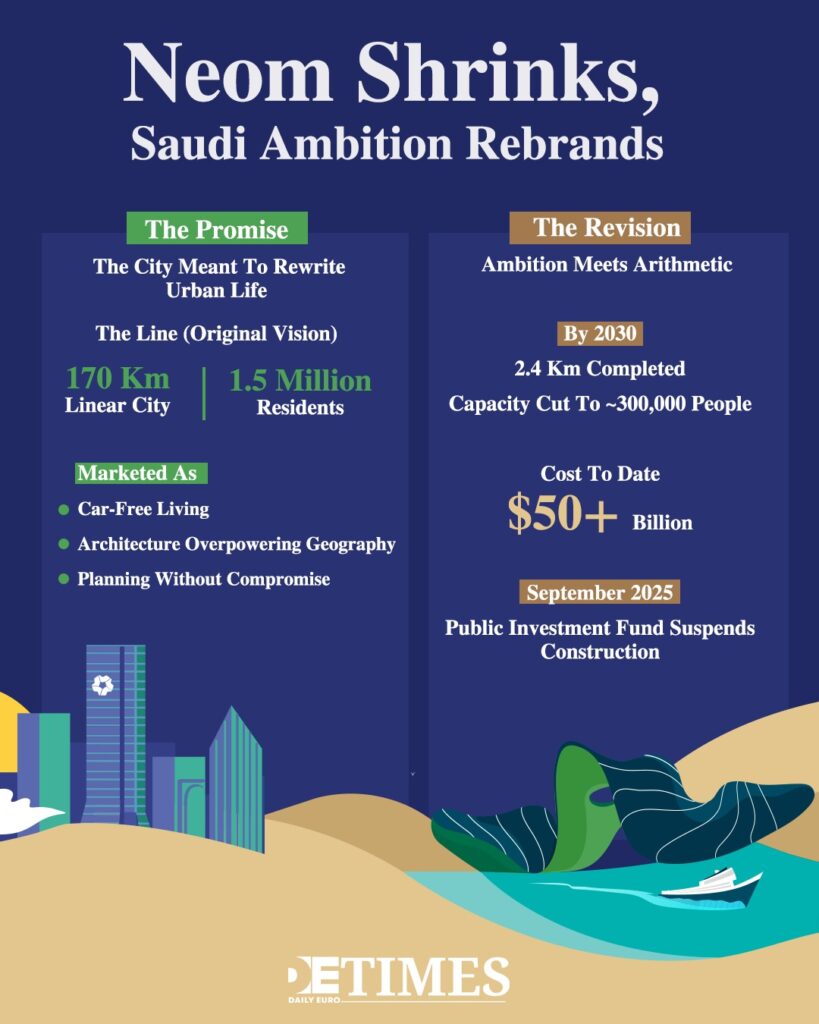
As reports emerged in November 2025 that only 2.4 kilometres of The Line will be completed by 2030, housing 300,000 people instead of 1.5 million, Saudi Arabia’s signature future-city is being trimmed into something far less cinematic.
Neom has always been presented as a leap beyond normal development. A place where design could outrun geography, and where planning could replace compromise. In that world, The Line was the headline, a 170-kilometre linear city that would reset how urban life works. Now it is being reduced and redesigned.
The shift is not only architectural. It is also psychological, because it shows the limits of even the most well-funded ambition. At least $50 billion has been spent. In September 2025, Saudi Arabia’s Public Investment Fund suspended construction until further notice.
The Utopia Meets the Spreadsheet
According to the Financial Times investigation in November 2025, Neom is undergoing a major review after years of delays, budget overruns and economic changes. The report says The Line will be “radically reimagined” into something more realistic. New CEO Aiman al-Mudaifer launched the review in late 2024 after Nadhmi al-Nasr departed.
This is not unusual in construction. Mega-projects often begin with the vocabulary of inevitability, then collide with engineering and cost. The surprise is how much Neom depended on spectacle as strategy. Saudi Arabia did not only sell a city. It sold an image of unstoppable momentum, as if the future could be ordered like a product.
From Living Space to Machine Space
The most revealing detail is the reported pivot in Neom’s purpose. Reports suggest the project may shift towards becoming a regional data centre hub, tied to Saudi Arabia’s AI ambitions and following the path of more successful Dubai investments.
It is a colder kind of future. A city implies people, streets, mistakes and daily life. A data hub implies infrastructure, efficiency and quiet power. This is still development, but it is no longer utopian. It is the future redefined as servers and cooling systems, not homes and public space.
Competing Futures Arrive at Once
The scale-back also reflects pressure beyond Neom itself. Lower oil prices and competing priorities such as Expo 2030 and the 2034 World Cup demand sequencing. Every mega-event needs roads, hotels, staffing and credibility. Those are tangible, deadline-driven demands.
The Line’s original plan for 16 modules dropped to 12, then seven, then four, and by end-2023 to just three. Trojena, the desert ski resort venue for the 2029 Asian Winter Games, is one of the few sites still moving at pace. Full completion is now projected for 2045.
A Smaller Vision May Travel Further
There is a counterargument worth taking seriously. Scaling back does not automatically mean failure. It can mean editing, and editing can be maturity. A reduced Neom might be more useful than an impossible one.
Yet the redesign also confirms a broader truth. Modern governments still love the idea of technology solving politics, and of architecture solving society. Neom’s recalibration suggests that even in Saudi Arabia, the future must still fit inside a budget.
Keep up with Daily Euro Times for more updates!
Read also:
Saudi’s AI Paradox: Future-Proofing Without an Environmental Plan
Foreign Groups Launch Multi-Front AI Attack Against France
NEOM Revisited: The Blueprint for Instant City Ventures