

In 1989, a twenty-six-year-old stood to help rebury Imre Nagy, martyr of the 1956 Hungarian Revolution. He electrified the crowd with a call for free elections and the departure of Soviet troops.
George Soros, the philanthropist, heard the speech and sent Viktor Orbán a $10,000 scholarship to study at Pembroke College, Oxford, where the young man studied civil society in European political thought.
That trajectory, from provincial reformist to the leader who drove George Soros’s Central European University out of Hungary decades later, is what Hungarians vote on in April. How a man arrives at that reversal tells us more about the mechanics of political survival than about ideological conviction.
The Long Ideological Journey Rightward
Viktor Orbán founded the Alliance of Young Democrats, or Fidesz, as a liberal movement opposing Hungary’s Marxist-Leninist government in 1988 and assumed the party’s presidency in 1993. Electoral defeat in 1994 proved the turning point: Viktor Orbán used that loss to reorient Fidesz sharply toward nationalism, courting the conservative vote that Prime Minister József Antall’s death had left leaderless.
A first government arrived in 1998, placing Viktor Orbán at the prime ministerial helm at thirty-five. A second defeat followed in 2002, after which Viktor Orbán constructed think tanks, civic bodies, and media channels, positioning Fidesz as the permanent vehicle of Hungarian conservatism. Those preparations served an institutional purpose as much as an electoral one, priming the party for outright dominance.
The Economics Behind the Ideology
The financial crisis of 2008 devastated Hungarian households carrying mortgages denominated in Swiss francs, and Viktor Orbán branded the incumbent coalition a “banker’s government” serving foreign interests over ordinary Hungarians. That message, rooted in genuine economic suffering, delivered a two-thirds parliamentary supermajority to Fidesz in 2010.
Viktor Orbán used the supermajority to strip the Constitutional Court of powers, gerrymander the electoral map, and transfer private media to loyalists. He publicly named the resulting system “illiberal democracy” in a 2014 speech, a label he wore as a badge of honour. The economic dividends, however, flowed toward those with the right connections in Orbán’s network.
Hungary’s economy grew at an average of just 0.5 per cent across 2024 and 2025, well below the EU average. Brussels withheld billions in EU funds over rule-of-law concerns, worsening a budget deficit projected at 5 per cent for both 2025 and 2026 – nearly double the EU target – leaving voters in a sour mood sixteen years into the experiment.
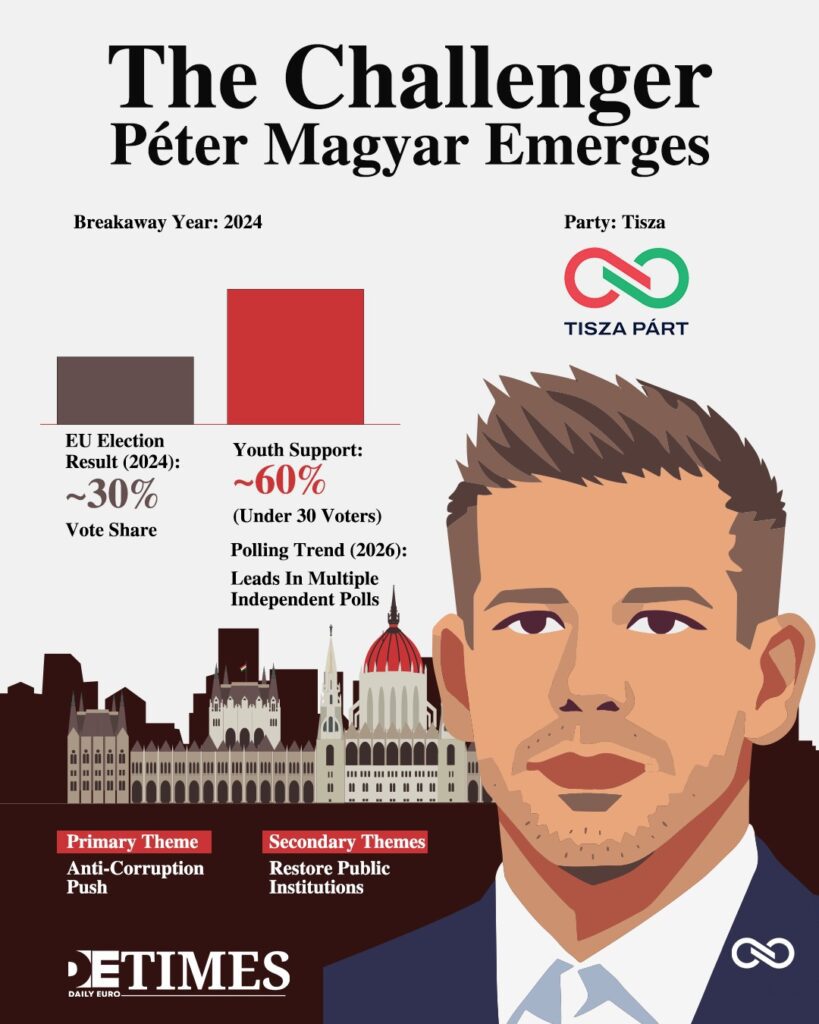
Péter Magyar and Hungary’s Reckoning
Péter Magyar broke from Fidesz in 2024 over the government’s pardon of a convicted accomplice in a child-abuse cover-up at a state-run children’s home, and publicly accused Viktor Orbán’s rule of being a “political product” concealing massive wealth transfers to connected loyalists.
His Tisza party secured nearly 30 per cent of the vote in the 2024 European Parliament elections, establishing Péter Magyar as the most formidable opponent Viktor Orbán has faced since 2010.
Independent polls placed Tisza ahead of Fidesz by double digits through early 2026, and more than 60 per cent of voters under thirty expressed support for Péter Magyar, a generational rupture striking at the arithmetic of Fidesz’s long-term coalition.
Magyar has focused his campaign on dismantling the corruption embedded in what he calls the “mafia state”, restoring public services, and recovering frozen EU funds.
In the final campaign weeks, allegations published that security services had directed police raids against two Tisza IT workers, after which Tisza’s supporter database circulated online. Péter Magyar branded the affair “Orbán-gate”. Political scientist Gábor Török wrote that using “state-owned, secret service tools” against an opposition party “is not a part of a normal political life”.
Whatever Happens, Turmoil Follows
The pre-election environment has produced fraud claims from both camps before voters cast a single ballot. It was alleged that Fidesz coordinated vote-buying across at least 53 constituencies through economic coercion and dependency networks affecting up to 600,000 voters.
It was reported that Russia’s Foreign Intelligence Service had proposed staging a false-flag assassination attempt on Viktor Orbán, a claim that a European intelligence service authenticated. Pro-Kremlin disinformation networks fabricated fake Euronews websites spreading false claims about Péter Magyar.
A Tisza victory would unlock frozen EU funds and open Hungary to institutional re-convergence with European governance standards.
Viktor Orbán’s loyalists hold positions across the state, public administration, the judiciary, and parts of the economy and the media, meaning structural change would stretch across generations.
A Fidesz win would entrench Hungary’s role as a disruptive actor inside EU decision-making, with veto power over foreign policy decisions serving as its primary tool.
European institutions, absent a sympathetic Washington, would manage a post-election legitimacy crisis comparable to Georgia’s disputed 2024 vote, in an information environment where both camps have already pre-positioned their fraud narratives, and the line between a genuine result and a contested one grows harder to hold.
The man who demanded that the ruling party “subject itself to free elections” in 1989 built a system to guarantee his own victories instead. Hungary votes on 12 April on whether that system has finally met an equal.
Keep up with Daily Euro Times for more updates
Read also:
Is Viktor Orbán’s Time in Power Up?
Orban Takes a Leaf Out of the Kremlin’s Book
Defying Brussels: The Budapest Shelter for Polish Officials