
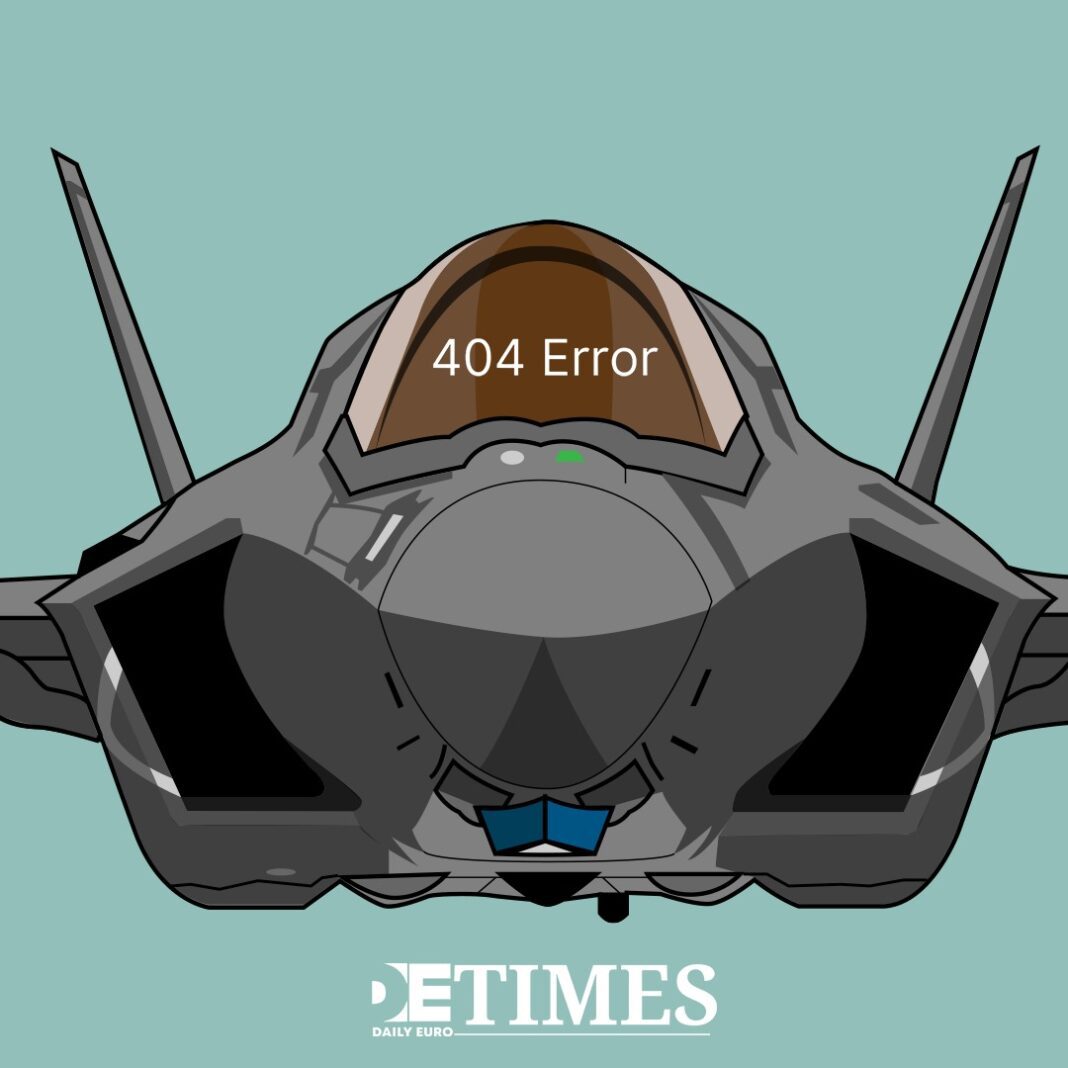
Last week, a Dutch defence official named Gijs Tuinman went on the radio and offered a comparison that defined a new era of European autonomy. He proposed that European allies could exercise sovereign digital control over their F-35 fighter jets by bypassing American software locks. The proposal marks a bold shift in Europe’s transition away from American arms.
He likened the procedure to ‘jailbreaking’ an iPhone and acknowledged the gravity of making such a statement in public.
The comment erupted like a flare and the words ricocheted through military circles throughout both sides of the ocean within hours. His message pointed to the intensifying fractures in the foundation of transatlantic trust.
A Dependency Built Into the Machine
The F-35 works as a flying computer with systems running on more than 8 million lines of code. The programme is built with inherent limits on the ability of an operator to modify the jet without asking for permission from Washington. In a crisis the most sensitive updates remain tied to a United States Air Force laboratory in Florida.
That condition defines the current status for thirteen European countries flying the plane. Tuinman mentioned that Washington has not disrupted any updates even if the vulnerability he described is a permanent feature of the architecture.
By talking about the situation on national radio he made a technical constraint into a deliberate political statement.
Trust Eroded by Accumulation
The blunt talk from Dutch officials arises from a long series of diplomatic abrasions. Repeated American assertions regarding the status of Greenland which is an autonomous territory of Denmark provided a backdrop for the pivot.
In August 2025 the Danish foreign minister called in the American representative in Copenhagen to address secret operations meant to encourage Greenland to break away. The friction led the Danish military intelligence service to officially categorise the United States as a security concern. Bureaucratic changes of that nature carry lasting consequences for the alliance.
Greenland is merely part of a broader trend where the two sides are moving apart. At the NATO summit in The Hague in June 2025 the official statement focused on a narrowed scope for Ukraine. The document omitted previous promises of membership and left out any mention of working with the European Union.
Such gaps pointed to a growing distance between the security priorities of the U.S. and its allies. Simultaneously Vice President J.D. Vance was publicly attacking European leaders in Munich. The American National Security Strategy even included language regarding the suppression of specific political groups. The pressure on European political independence is now a central theme of the partnership.
Switzerland Votes With Its Procurement Budget
Loss of confidence is now appearing as delayed projects and cancelled contracts. In July 2025 the Swiss defence ministry put off getting American Patriot missile systems. The decision followed an American turn to unilaterally prioritise other parts of the world over existing contracts.
Switzerland had already committed nearly 700 million Swiss francs as a down payment and expected the system to be ready by 2026. Instead Washington changed the delivery rules without any prior consultation with Bern. This move forced the country to look elsewhere for its security needs.
A spokesperson for the Swiss defence ministry said they were left with a vacuum of information regarding the American contracts. A group called EUROSAM stepped in with a different system called SAMP/T. The manufacturers provided Switzerland with a guaranteed delivery timeline and stated that a new order placed today would result in a functioning system by 2029.
Clarence Chollet who is a member of parliament noted that the European option is now the most viable way ahead because the American systems have become unreliable. Denmark took a similar route in September 2025 by picking the European system over the Patriot. The decision proved that being able to count on a supplier is now the primary metric for buying weapons.
Interdependence Without Illusion
Recent developments do not mean Europe is leaving NATO or saying no to American nuclear protection. The 2026 U.S. National Defense Strategy says that America will still provide high-level intelligence and backup. However the responsibility for day to day readiness and equipment maintenance is moving toward an autonomous European pillar.
Leaders like Friedrich Merz of Germany and Emmanuel Macron of France and Keir Starmer of the U.K. recently agreed on the new way ahead. Merz told a crowd in Munich that self-reliance is the necessary path as the United States continues to pull away.
The language from a German leader indicates a fundamental change in the strategic environment.
European leaders watched as their security became a bargaining chip. They saw the software in their own aircraft described as a risk and they watched major contracts dissolve into a vacuum of information. As a recent report from Chatham House concludes, the push to stand on their own is a permanent evolution. This will outlast any single administration because the weaknesses that caused the change are built into the very structure of the supply chain.
Keep up with Daily Euro Times for more updates!
Read also:
Europe’s Largest Warship: Securing Defence Autonomy in Air-Sea Battle
Make Europe Secure Again: Gulf Energy Underwrites Europe’s Transition
Britain Goes Nuclear: Europe’s New Security Leader

