

In Switzerland, the national broadcaster is preparing to cut 900 jobs by 2029. This trend is visible across the 27 countries of the European Union, where public media funding has dropped by over seven per cent in the last decade.
The fiscal ledgers merely show the surface of a wider move toward a new system.
The true transformation is found in the code owned by the Silicon Valley giants that Europeans use every hour of the day. Global advertising sales are now dominated by Google, Meta, and Amazon. Together they claim over half of all global spend, and that share rises to 61 per cent outside of China.
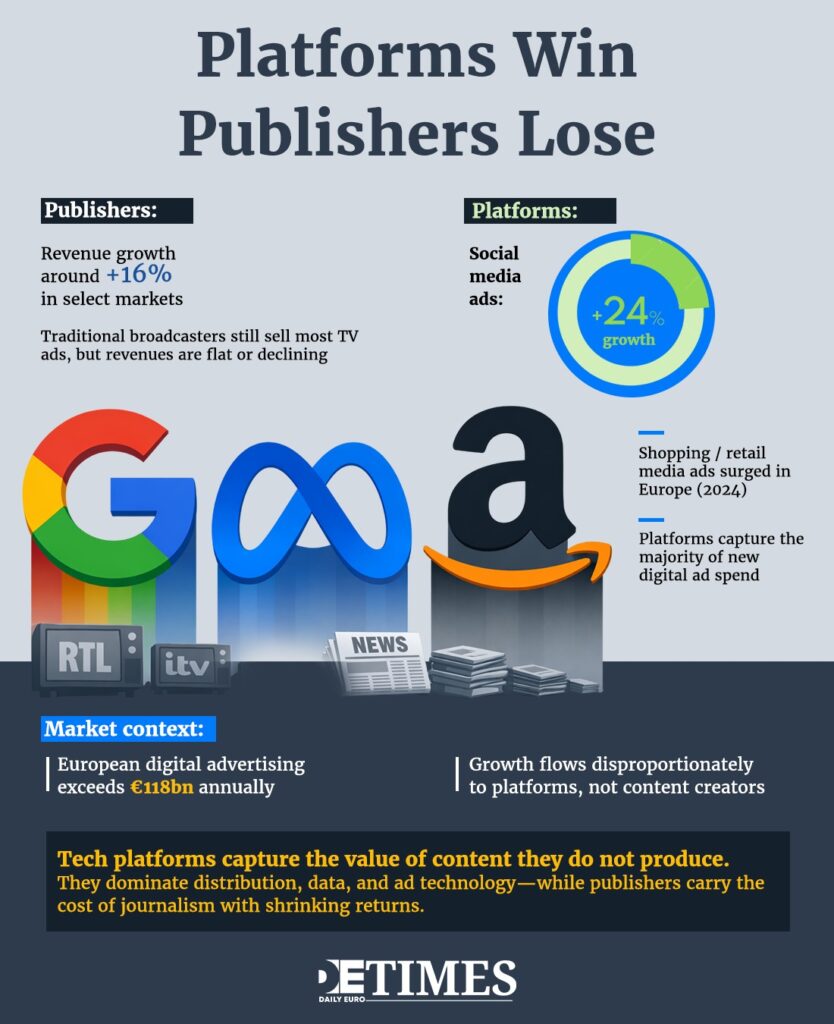
Although local outlets struggle, the European digital ad market has grown to more than €118 billion a year.
An era of independent discourse gave way to a quiet handover. Richard Burnley, a legal director at the European Broadcasting Union, notes that a few Big Tech “gatekeepers” now hold a strong grip on public opinion. This makes local European media much harder for the public to find.
Where Advertising Money Flows
The United Kingdom serves as a guide for the rest of the continent. Google and Meta taking at least half of the £42 billion spent on ads last year shows the scale of the shift.
Because Google handles nine out of ten web searches in the U.K., the corporation effectively dictates a £15 billion revenue stream.
Meta has a similar presence, claiming 60 per cent of social media visits and a £6 billion share of the current market.
In today’s digital economy, the financial rewards of the news cycle accrue to the distributors. Publishers managed a 16 per cent growth in some markets.
But social media platforms outpaced those groups with a jump of nearly 24 per cent. Shopping-based ads also saw strong growth across Europe in 2024.
Tech platforms have become the main winners of a content cycle they do not produce. Big TV groups like RTL and ITV sell a large portion of all TV ads in Europe, but their income has stalled while platform revenues soar.
Broadcasters are left hollowed out and struggling to pay for original reporting, as tech companies have positioned themselves as the indispensable middlemen between the creators and the audience.
Algorithms Replace Editorial Judgement
The careful choices once made by editors have been replaced by Californian engineering. Decisions that used to happen in newsrooms in London or Paris are now handled by systems built to get clicks.
These algorithmic systems are hard-wired to reward content that gets an instant reaction, a process that naturally leads to people staying in their own ideological enclaves.
Research suggests that an algorithm designed to show people exactly what they like actually exacerbates social friction. These invisible systems favor stories that provoke strong feelings, a standard that has drifted far from traditional journalistic ethics.
As social media today thrives on the construction of echo chambers, digital enclaves keep users captive by showing them a mirror of their own biases. The resulting polarisation fractures society.
The Gravity of Digital Monopoly
Most European media groups started in an era of sovereign stability. Today, these organisations are tethered to proprietary systems they neither own nor understand.
Online-only companies are on track for another rise in ad revenue this year.
Nearly nine out of every ten new dollars spent on ads this year will go to businesses that exist only online. Half of that goes directly to Alphabet, Amazon, and Meta. By next year, these platforms are expected to handle over 70 per cent of all ad spending in the world.
This concentration of wealth creates a kind of cultural gravity. Publishers must fight for survival against the same companies they use to reach their audience.
When a few platforms dominate, the variety of the media environment withers, making it harder for the public to encounter different perspectives.
How Transformation Happened
The most striking part of this change is how little friction it met. European societies watched as public broadcasters faded as audiences moved toward platforms that profit from the labour of others.
So, as the audience split into small digital groups, the shared experience of public media started to evaporate.
Fragmentation became the platforms’ greatest weapon. Every isolated creator, working without the support of a big newsroom, became more tethered to Silicon Valley for reach.
Platforms gathered the audience as creators fought for the remaining attention. Social media giants have spent a lot of money proving they can provide a return on investment, making the move to digital feel like an economic inevitability.
Regulators are now trying to catch up, but the new system is already the foundation of European media.
European officials have recently noted that Google holds a monopoly over the technology used for online ads. These realisations come years after the economic shift became irreversible. The habits have formed and the bonds have tightened.
The Private Square
The public conversation in Europe now flows through private pipes designed to keep users watching. The conversation about European digital sovereignty remains a hot topic among policymakers and industry leaders. Digital advertising now claims over two-thirds of all ad spend in Europe.
According to Daniel Knapp, an economist at IAB Europe, this is the new base of the media economy. Changing course will take more than new laws; it will require a fundamental reimagining of a public square that now operates on private rules.
Keep up with Daily Euro Times for more updates!
Read also:
Bosnia Off Air: Will Brussels Let the Last Broadcaster Die?
Trump’s Empty Lawsuit and the Necessity of the BBC
Starlink, Grok, and the Price of Private Infrastructure